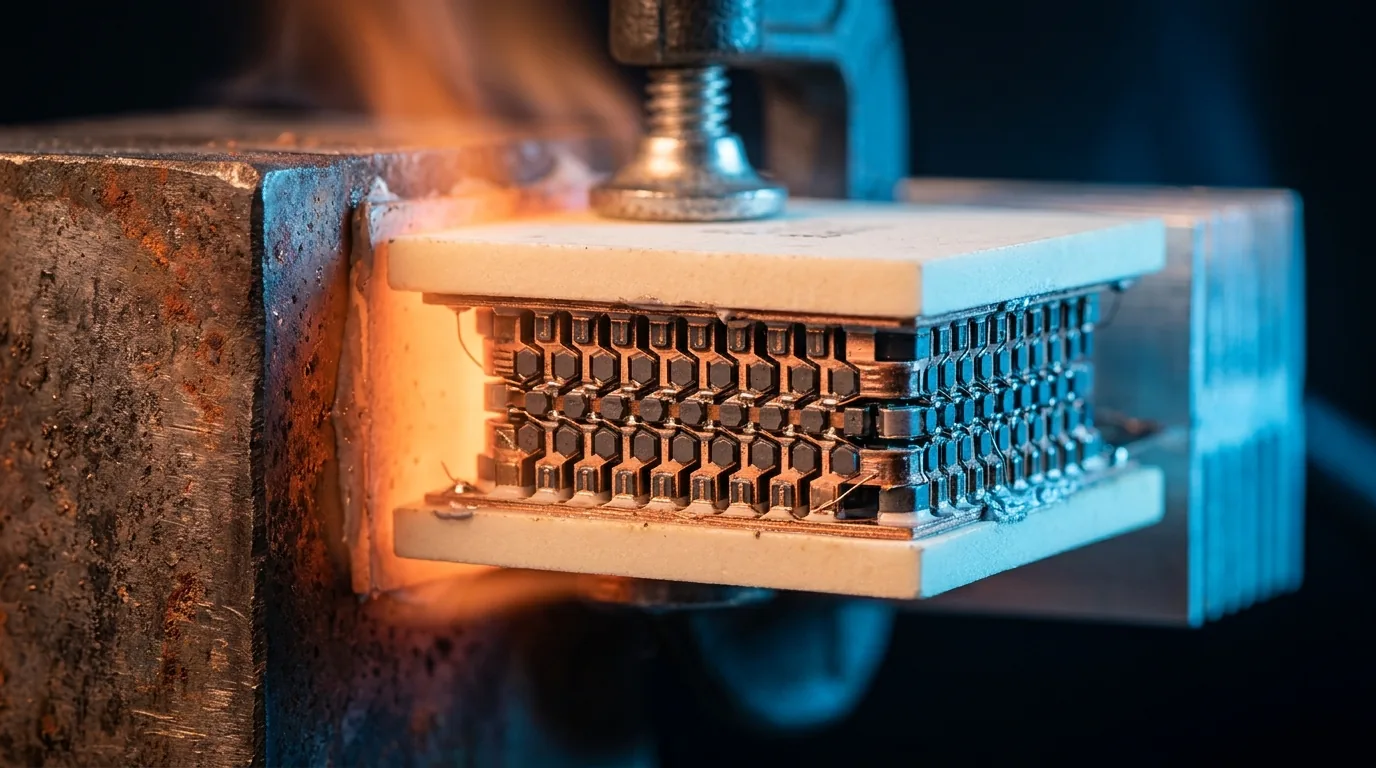
Area 03
Thermoelectrics and waste-heat recovery
Cement plants, breweries and diesel gensets reject gigawatts of heat. Electron–phonon transport in earth-abundant materials.
Context
Cement plants, breweries, food processing and the very large fleet of diesel gensets reject thermal power on the gigawatt scale, at perfectly usable temperatures. None of these sources is recovered.
High-performance commercial thermoelectrics rest on tellurium and bismuth, both scarce and expensive. The scientific question is how far the figure of merit of compounds built on abundant elements (copper, sulfur, iron, antimony, oxides) can be pushed.
Open questions
What the literature does not settle
Copper tetrahedrites: what mechanism locks lattice thermal conductivity near its amorphous limit, and how far does cationic substitution allow electrical and thermal conductivity to be decoupled?
Filled skutterudites: is the description of filler atoms as independent localised vibrational modes sufficient to account for phonon scattering, or is full anharmonic coupling required?
Thermoelectric oxides: what real gain do band engineering and energy filtering at grain boundaries bring to the power factor at high temperature?
Under a permanent thermal gradient and an industrial flue-gas atmosphere, which diffusion and oxidation mechanisms at the contacts limit module lifetime?
Does an ab initio calculation of electron–phonon transport correctly predict the figure of merit of these compounds with no fitted parameter?
Feasibility
Ab initio screening precedes and directs synthesis. A cluster, a planetary mill and a hot press cover the full loop from calculation to synthesis to measurement.
Methods and facilities
- DFT band-structure and electronic transport calculations (Boltzmann equation)
- Lattice thermal conductivity from ab initio phonons with third-order anharmonicity
- Synthesis by mechanical alloying and pressure-assisted sintering
- Seebeck coefficient, electrical conductivity and thermal diffusivity measurements versus temperature
- Full-module modelling and contact-loss analysis
Target outcome
Abundant-element thermoelectric modules sized for heavy-industry and diesel-genset waste heat, and an ab initio predictive capability usable in collaboration.
Simulated production chain
Thermoelectric synthesis and module line, on-site integrationFrom ab initio screening of a compound to a heat exchanger on a stack or a diesel exhaust.Related areas

Computational physics
DFT, molecular dynamics, multiphysics simulation: electronic structure, phonon transport and point defects.
Read more
Electronic materials from abundant resources
Indium-free transparent conducting oxides, iron-based soft magnetic materials, dielectric ceramics.
Read more
Materials physics for biomass and combustion
Pyrolysis and gasification kinetics of cocoa and palm residues, heat transfer in fixed beds, catalysts.
Read more