Area 09
Electronic materials from abundant resources
Indium-free transparent conducting oxides, iron-based soft magnetic materials, dielectric ceramics.
Context
Between an extracted ore and a finished electronic component lies a transformation chain (ore, powder, thin film or sintered ceramic), each step of which raises unresolved materials-physics questions for these particular resources.
Three families concentrate the interest: transparent conducting oxides as alternatives to indium tin oxide, iron-based soft magnetic materials for distribution transformers, and lead-free dielectric ceramics.
Open questions
What the literature does not settle
Indium-free transparent conducting oxides: what is the physical limit of the conductivity–transparency trade-off, and what exact role do grain boundaries play in effective mobility?
Iron-based soft magnetic materials: what microstructure simultaneously minimises eddy-current and hysteresis losses in a distribution transformer core?
Lead-free dielectric ceramics: what is the physical origin of permittivity drift with temperature and humidity, and can composition compensate for it?
Which impurities in lateritic and bauxitic ores are disqualifying for electronic properties, and above what threshold? The physics of unintentional doping.
Can a complete ore → powder → functional material chain be established with low-energy processes compatible with an unstable electricity grid?
Feasibility
Sol-gel, spray pyrolysis and conventional sintering are direct synthesis routes. Characterisation (four-point probe, spectrophotometry, impedance spectroscopy, hysteresis measurement) needs standard equipment, and computation supports interpretation.
Methods and facilities
- Synthesis by sol-gel, spray pyrolysis and conventional sintering
- Four-point-probe and Hall-effect electrical characterisation
- UV-visible spectrophotometry and optical gap measurement
- Frequency-resolved magnetic characterisation and loss separation
- Ab initio calculation of defects, doping and band structure
Target outcome
Scientific valorisation of abundant mineral resources into electronic materials, and synthesis processes transferable to an industrial partner.
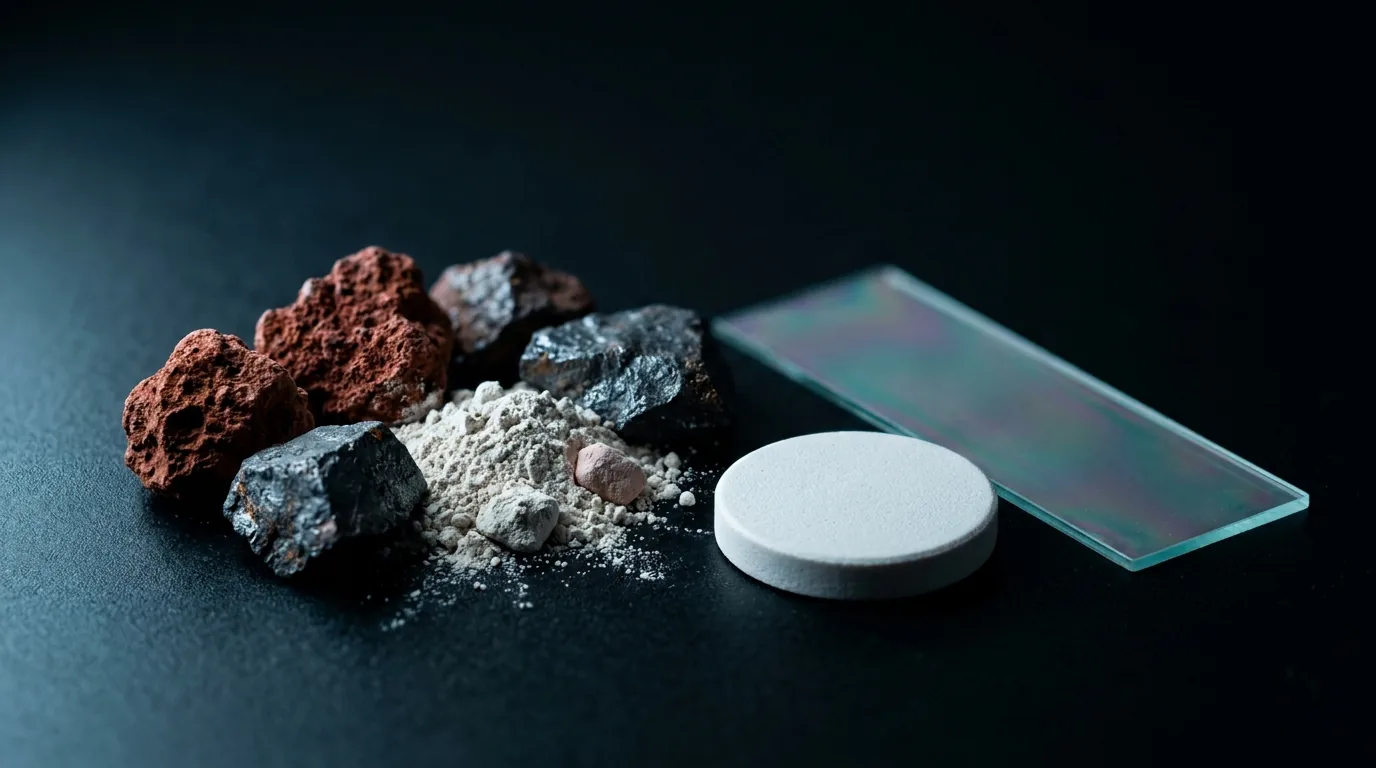
Simulated production chain
Ore → electronic material chainsBauxite → alumina → ceramics; iron → magnetic laminations; rutile → conducting oxides.Related areas

Computational physics
DFT, molecular dynamics, multiphysics simulation: electronic structure, phonon transport and point defects.
Read more
Post-lithium battery physics
Sodium-ion, iron flow batteries, lead-carbon: the physics of storage outside the lithium supply chain.
Read more
Discharge and lightning physics
The Congo basin is the most thunderstorm-prone region on Earth, and the physics of lightning–grid coupling there is almost unexplored.
Read more