Area 02
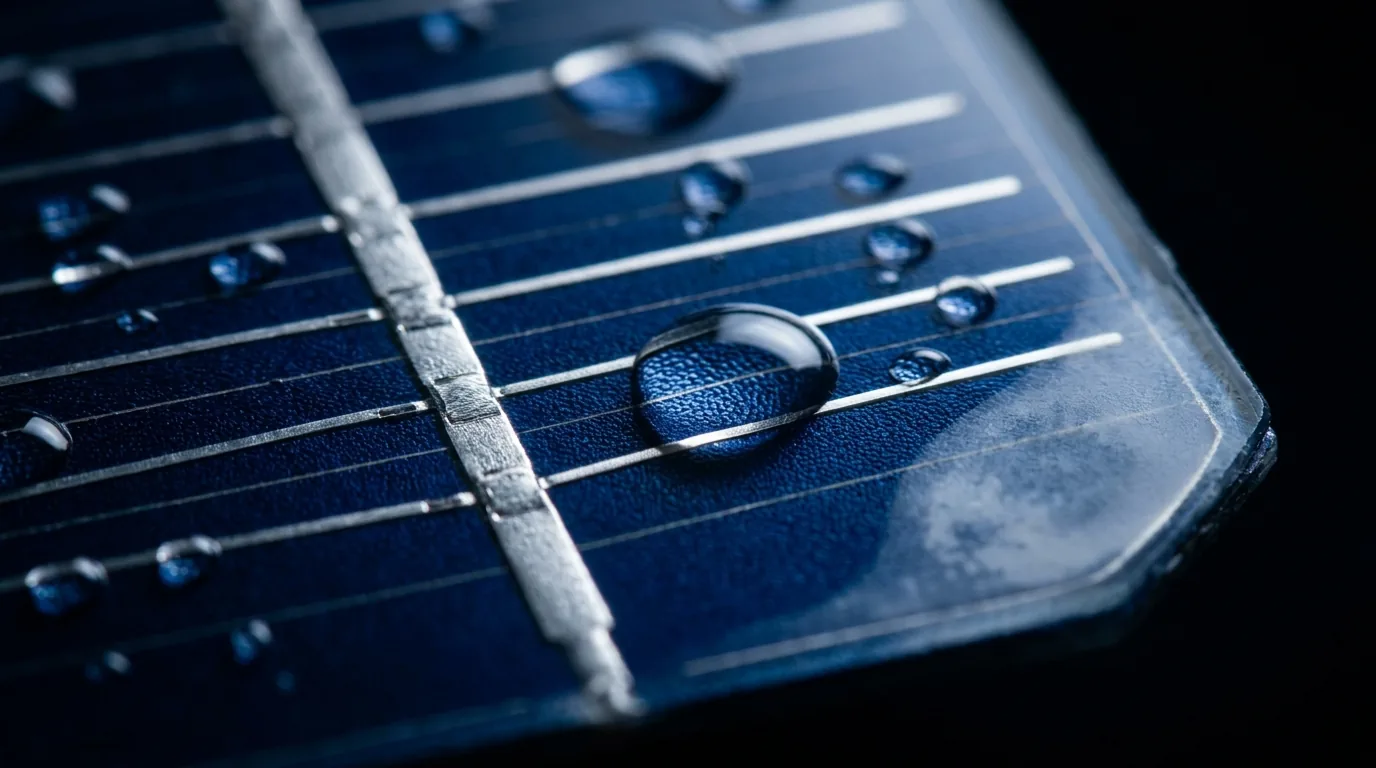
Photovoltaics in the humid tropics
Imported modules are qualified for temperate or desert climates. Their ageing physics under permanent 80 % humidity is a blind spot.
Context
Photovoltaic qualification standards were written from European, North American and desert field experience. Their damp-heat test compresses twenty years of tropical exposure into a thousand hours, with acceleration factors never validated on the terrain that concerns us.
A yield question compounds it: the equatorial belt has heavy cloud cover and a diffuse-dominated irradiance regime for much of the year. Production models calibrated on direct-dominated sites are systematically biased there.
Open questions
What the literature does not settle
What are the real acceleration factors between the standard damp-heat test and continuous tropical exposure? Does the Arrhenius–Peck law hold under day–night cycling with condensation?
Encapsulant delamination, ribbon corrosion and potential-induced degradation under sustained humidity above 80 %: what is the dominant causal chain, and are these mechanisms additive or coupled?
Thermal and hygroscopic stability of halide perovskites and organic cells: can intrinsic material degradation be decoupled from water permeation through the encapsulation?
Yield models under diffuse-dominated irradiance: what spectral and angular correction for an equatorial overcast sky, and what accuracy gain on annual production?
Which electrical signature (I–V curve, electroluminescence, thermography) corresponds to each ageing mechanism, and can a non-destructive field diagnostic be derived from it?
Feasibility
An instrumented outdoor exposure field, an I–V tracer and an electroluminescence camera are enough to start. Real-condition ageing data accumulates over several years.
Methods and facilities
- Instrumented outdoor exposure field: global and diffuse irradiance, module temperature, relative humidity
- I–V tracing, electroluminescence imaging and infrared thermography
- Accelerated ageing in a cycled climatic chamber, benchmarked against real-world ageing
- Impedance spectroscopy on cells and mini-modules
- Optical modelling of diffuse irradiance and drift-diffusion cell simulation
Target outcome
A photovoltaic qualification laboratory for the humid tropics, and a representative accelerated-test protocol that can be held against suppliers.
Simulated production chain
Photovoltaic encapsulation line and qualification laboratoryLamination, framing and qualification testing calibrated on three climate profiles.Related areas

Reliability physics in tropical environments
Electromigration, board-level corrosion, moisture diffusion in encapsulants, thermomechanical solder-joint fatigue.
Read more
Metrology and secondary standards
A country without secondary standards can neither certify nor export. Fundamental physics with immediate industrial impact.
Read more
Wide-bandgap semiconductors for power electronics
SiC and GaN tolerate heat and overvoltage better than silicon. Traps, defects and interface transport.
Read more