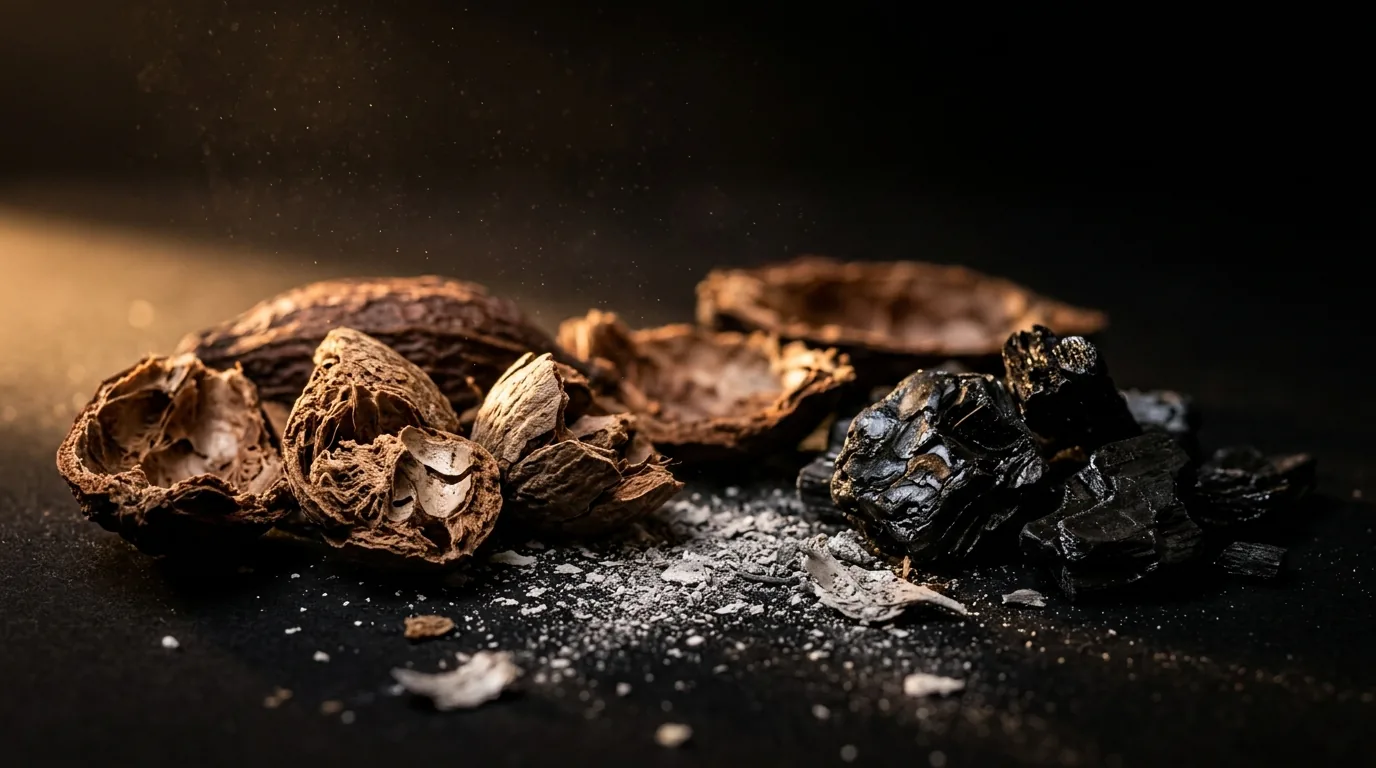
Area 04
Materials physics for biomass and combustion
Pyrolysis and gasification kinetics of cocoa and palm residues, heat transfer in fixed beds, catalysts.
Context
Cocoa and oil-palm production yields considerable annual volumes of pods, shells and empty bunches, today burned in the open or left to decompose. Their energy content is real; the physics of their conversion is poorly known.
Available kinetic models were established on temperate biomass: wood, straw, cereal residues. Tropical residues, richer in lignin and potassium and far wetter, depart from these enough to make extrapolation wrong.
Open questions
What the literature does not settle
Pyrolysis kinetics of palm kernel shells and cocoa pods: do independent parallel-reaction models correctly describe devolatilisation, and why do apparent activation energies drift with heating rate?
In a fixed bed, which regime is limiting (intraparticle conduction, bed convection, chemical kinetics) as a function of particle size and initial moisture?
Physics of tar formation and cracking in gasification: which catalysts based on iron oxides or locally produced activated carbon are effective, and by what mechanism?
Potassium-rich ashes: can the melting point and the agglomeration threshold be predicted from elemental composition alone?
How should non-equilibrium gas mixtures downstream of a fixed-bed gasifier be described thermodynamically, and how valid is the local-equilibrium assumption?
Feasibility
A thermobalance, a tube furnace and a gas chromatograph make up most of the setup. The residue feedstock is available close to the study sites.
Methods and facilities
- Thermogravimetric analysis and differential scanning calorimetry under controlled atmosphere
- Temperature-instrumented tubular pyrolysis and gasification reactor
- Gas chromatography of syngas and tars
- Kinetic model identification by isoconversional methods and Bayesian fitting
- Simulation of coupled heat and mass transfer in porous media
Target outcome
Reference kinetic and thermophysical data for cocoa and palm residues, and the design basis for gasifiers genuinely suited to these feedstocks.
Simulated production chain
Pyrolysis, gasification and briquetting unitFrom seasonal residue collection to cleaned gas feeding an engine or a boiler.Related areas
Thermoelectrics and waste-heat recovery
Cement plants, breweries and diesel gensets reject gigawatts of heat. Electron–phonon transport in earth-abundant materials.
Read more
Computational physics
DFT, molecular dynamics, multiphysics simulation: electronic structure, phonon transport and point defects.
Read more
Building materials and building thermal physics
Air conditioning is the largest tertiary-sector electricity load. Phase-change materials, bio-based insulation, coupled transfers.
Read more