Area 10
Computational physics
DFT, molecular dynamics, multiphysics simulation: electronic structure, phonon transport and point defects.
Context
Electronic structure, phonon transport and point defects are now computed with enough accuracy to direct experiment rather than comment on it after the fact.
This is not a computing service: the area carries its own methodological questions, on the validity of these methods applied to strongly correlated oxides, strongly anharmonic compounds and electrochemical interfaces (the precise systems of the other eleven areas).
Open questions
What the literature does not settle
Exchange-correlation functionals for strongly correlated transition-metal oxides: which correction (DFT+U, hybrid functionals, non-local approaches) for which property, and at what cost?
Lattice thermal conductivity from the phonon Boltzmann equation: how far does anharmonic perturbation theory remain valid in ultralow-conductivity compounds?
Multiscale modelling of electrode–electrolyte interfaces: how can ab initio molecular dynamics, classical force fields and continuum models be rigorously matched?
Coupled thermal–electrical–mechanical simulation of device ageing: what level of model reduction preserves predictive power over multi-year timescales?
Which machine-learning strategies (learned interatomic potentials, materials screening) are genuinely cost-effective relative to the compute they demand?
Feasibility
The software is free, and every computed result directs a future experiment rather than replacing it.
Methods and facilities
- Density functional theory, electronic structure and point defects
- Ab initio phonons and thermal transport, Boltzmann electronic transport
- Ab initio and classical molecular dynamics, learned potentials
- Finite-element and finite-volume multiphysics simulation
- Workflow automation, data management and reproducibility
Target outcome
A shared computing platform and a computational physics team feeding predictions and interpretation into the other eleven areas.
Simulated production chain
The laboratory itself, and feasibility studiesThe computing infrastructure carrying the other eleven chains, and the feasibility studies it makes possible.Related areas
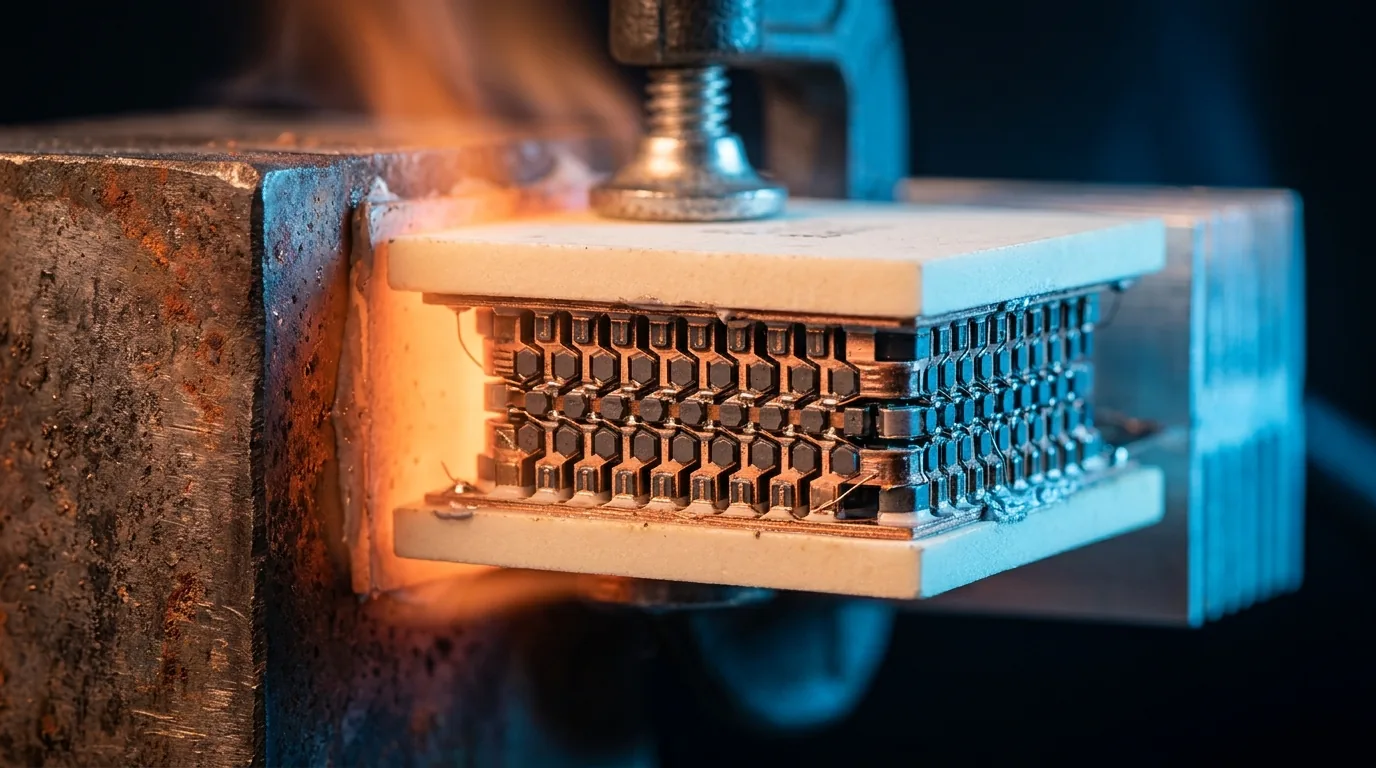
Thermoelectrics and waste-heat recovery
Cement plants, breweries and diesel gensets reject gigawatts of heat. Electron–phonon transport in earth-abundant materials.
Read more
Post-lithium battery physics
Sodium-ion, iron flow batteries, lead-carbon: the physics of storage outside the lithium supply chain.
Read more
Wide-bandgap semiconductors for power electronics
SiC and GaN tolerate heat and overvoltage better than silicon. Traps, defects and interface transport.
Read more