Area 06
Reliability physics in tropical environments
Electromigration, board-level corrosion, moisture diffusion in encapsulants, thermomechanical solder-joint fatigue.
Context
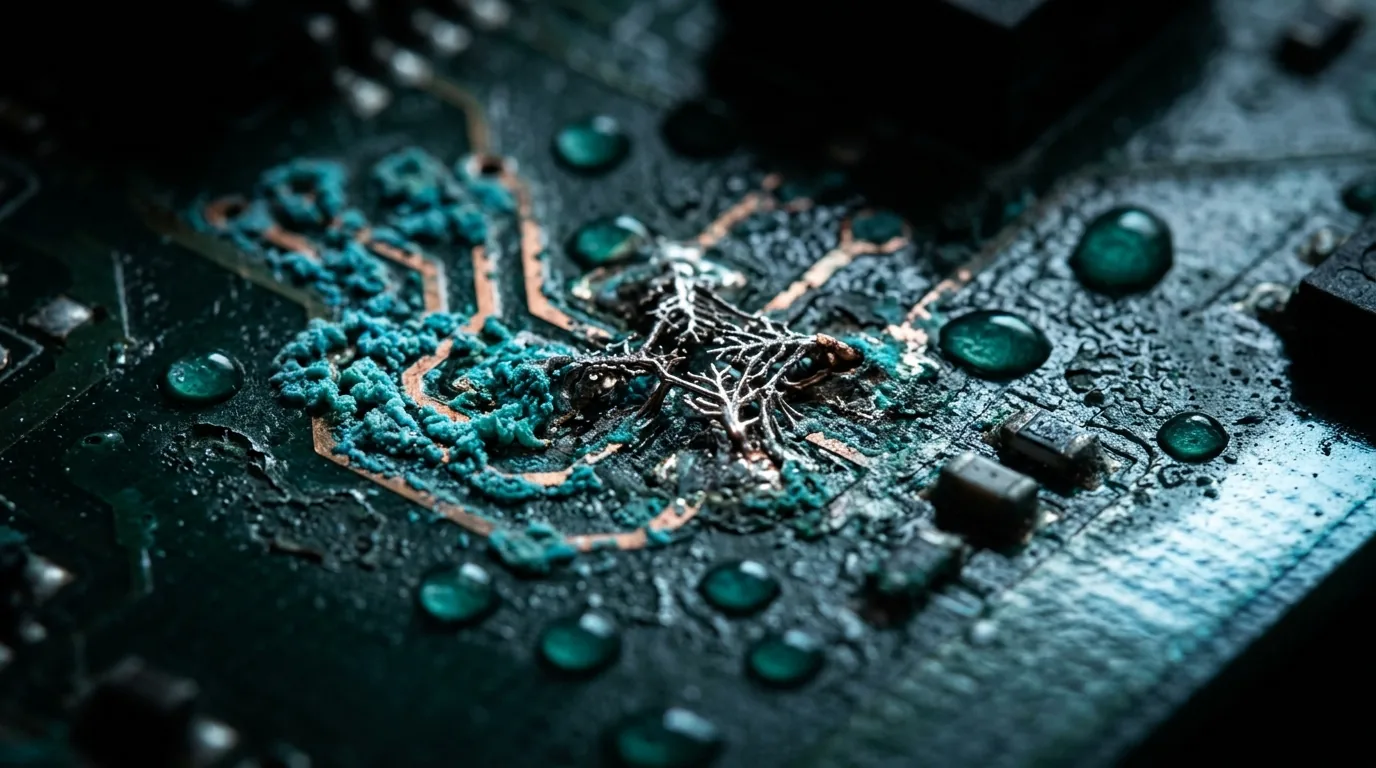
Electronic equipment deployed in the humid tropics is designed and qualified for other climates. Observed failure rates on telecom equipment, inverters and meters are wildly out of proportion with manufacturer specifications, and nobody measures why.
Behind that observation lies precise physics: water diffusion in encapsulating polymers, surface electrochemistry on printed circuit boards, cyclic damage in solder joints, mass transport under high current density. And a failure statistics whose parameters were calibrated on climates that are not ours.
Open questions
What the literature does not settle
Moisture diffusion in epoxy and silicone encapsulants: what diffusion coefficients and sorption isotherms between 30 and 40 °C above 80 % relative humidity, and how does water uptake modify internal stresses?
Electrochemical corrosion and electrolytic migration on printed circuit boards under condensation: is there a residual ionic contamination threshold beyond which time-to-failure collapses?
Electromigration in interconnects at elevated junction temperature: do Black-type models remain predictive outside their calibration domain?
Thermomechanical fatigue of lead-free solder under coupled temperature–humidity cycling rather than purely thermal cycling: what damage law, and what correction to Coffin–Manson relations?
Do the Arrhenius, Peck and Norris–Landzberg acceleration models have parameters transferable to the tropical climate, or must they be recalibrated? What Weibull form actually describes the failures observed in the field?
Feasibility
A cycled climatic chamber, printed-circuit test vehicles and a measurement station are enough to produce the data. Failed equipment is collected on site.
Methods and facilities
- Accelerated testing in cycled temperature–humidity chambers with continuous electrical monitoring
- Dedicated test vehicles: interdigitated combs, solder-joint daisy chains, electromigration structures
- Water-sorption gravimetry and impedance spectroscopy on encapsulants
- Failure analysis: microscopy, metallographic cross-sections, ionic contamination analysis
- Failure statistics: Weibull estimation, censoring, hierarchical acceleration models
Target outcome
An accelerated-testing laboratory and a “humid tropical” qualification standard, intended for importers, telecom operators and energy distributors in tropical regions.
Simulated production chain
Board tropicalisation line and accelerated-testing laboratoryFrom conformal coating applied to a board to predicted lifetime by product class.Related areas
Photovoltaics in the humid tropics
Imported modules are qualified for temperate or desert climates. Their ageing physics under permanent 80 % humidity is a blind spot.
Read more
Metrology and secondary standards
A country without secondary standards can neither certify nor export. Fundamental physics with immediate industrial impact.
Read more
Wide-bandgap semiconductors for power electronics
SiC and GaN tolerate heat and overvoltage better than silicon. Traps, defects and interface transport.
Read more