Area 05
Physical hydrology and small hydropower
Flood and low-flow regimes under climate variability, fluid mechanics of low-head turbines.
Context
The small-hydro potential of equatorial basins is largely untapped, and the obstacle is not primarily financial: it is informational. Most attractive sites are ungauged, and the uncertainty on producible energy is enough to deter financing.
A deeper physical question compounds it: available hydrological series are short, and climate variability makes the stationarity assumption underpinning all classical sizing hard to defend.
Open questions
What the literature does not settle
Do stationary extreme-value distributions remain valid for floods and low flows in equatorial basins, or are explicitly non-stationary models required?
What is the statistical structure of flow intermittency (long memory, scale invariance) in equatorial basins with a double rainy season?
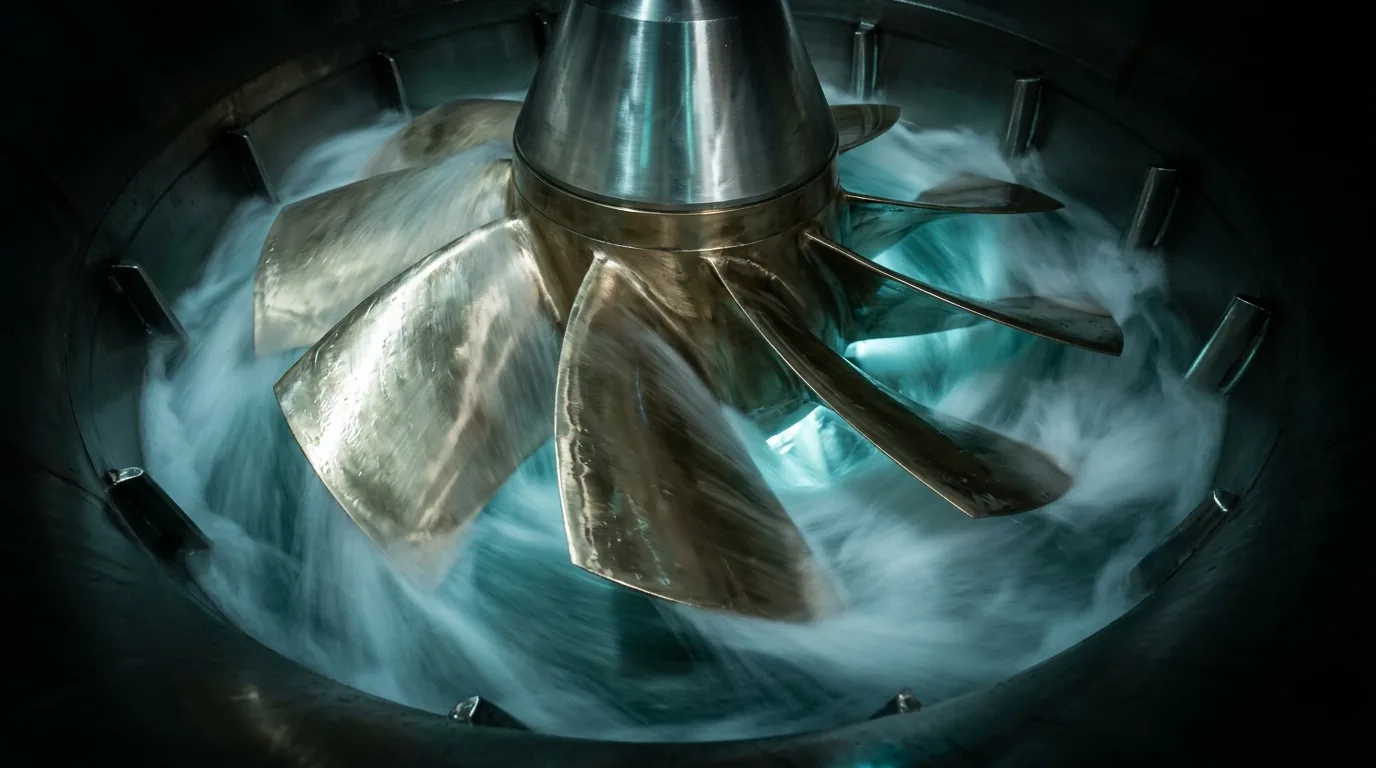
Fluid mechanics of low-head turbines: where do separation and cavitation losses sit in runners operating at low Reynolds number and in Archimedes screw turbines?
What physics governs blade erosion under the high sediment load typical of tropical rivers in the rainy season, and how should it be modelled?
What minimal hydrological information (duration, frequency, measurement type) is sufficient to bound the production uncertainty of an ungauged site?
Feasibility
Most of the work is modelling and light instrumentation: autonomous pressure sensors, spot gauging, numerical simulation on the cluster.
Methods and facilities
- Basin instrumentation with pressure sensors and control gauging
- Non-stationary extreme-value statistics and multifractal analysis of discharge series
- Hydrological regionalisation for ungauged sites
- Numerical simulation of turbine flows, validated on a reduced-scale rig
- Uncertainty quantification of producible energy
Target outcome
A method for assessing producible energy at ungauged sites and a design model for low-head turbines, directly usable by grid operators and mini-hydro developers.
Simulated production chain
Fleet of run-of-river mini power plantsFrom the hydrology of an ungauged basin to the pre-design of a series-manufacturable turbine.Related areas

Computational physics
DFT, molecular dynamics, multiphysics simulation: electronic structure, phonon transport and point defects.
Read more
Metrology and secondary standards
A country without secondary standards can neither certify nor export. Fundamental physics with immediate industrial impact.
Read more
Photovoltaics in the humid tropics
Imported modules are qualified for temperate or desert climates. Their ageing physics under permanent 80 % humidity is a blind spot.
Read more