Area 01
Post-lithium battery physics
Sodium-ion, iron flow batteries, lead-carbon: the physics of storage outside the lithium supply chain.
Context
The laboratory works with cobalt, nickel and iron resources, and with no lithium. Building a storage industry on lithium chemistry would mean importing the entire value chain and depending on a globally strained supply.
Alternative chemistries (sodium-ion, iron flow batteries, lead-carbon) are documented at temperate room temperature. Their behaviour at 35–40 °C, the ordinary thermal regime of an unconditioned technical room, remains poorly characterised. That is exactly where the open questions sit.
Open questions
What the literature does not settle
Degradation of Na–Ni–Mn layered oxide sodium-ion cathodes between 35 and 40 °C: what are the respective contributions of desodiation-driven phase transitions, manganese dissolution and intergranular cracking?
Prussian blue analogues: what role do zeolitic water and [Fe(CN)₆] vacancies play in capacity fade during high-temperature cycling?
Ionic transport in concentrated aqueous and iron-based flow-battery electrolytes: diffusion coefficients, transference numbers and speciation as functions of temperature and pH.
Electrode–electrolyte interface in lead-carbon batteries: by what mechanism does the microstructure of the carbon additive suppress negative-plate sulfation?
Is there an electrochemical signature (impedance spectroscopy, differential voltage analysis) that separates these degradation mechanisms in operando, without disassembling the cell?
Feasibility
A potentiostat, a cycling bench and a regulated thermal chamber are enough to produce the data. Diffraction and microscopy come through collaboration.
Methods and facilities
- Galvanostatic cycling and electrochemical impedance spectroscopy in a regulated thermal chamber
- Differential capacity (dQ/dV) and differential voltage analysis to deconvolve ageing mechanisms
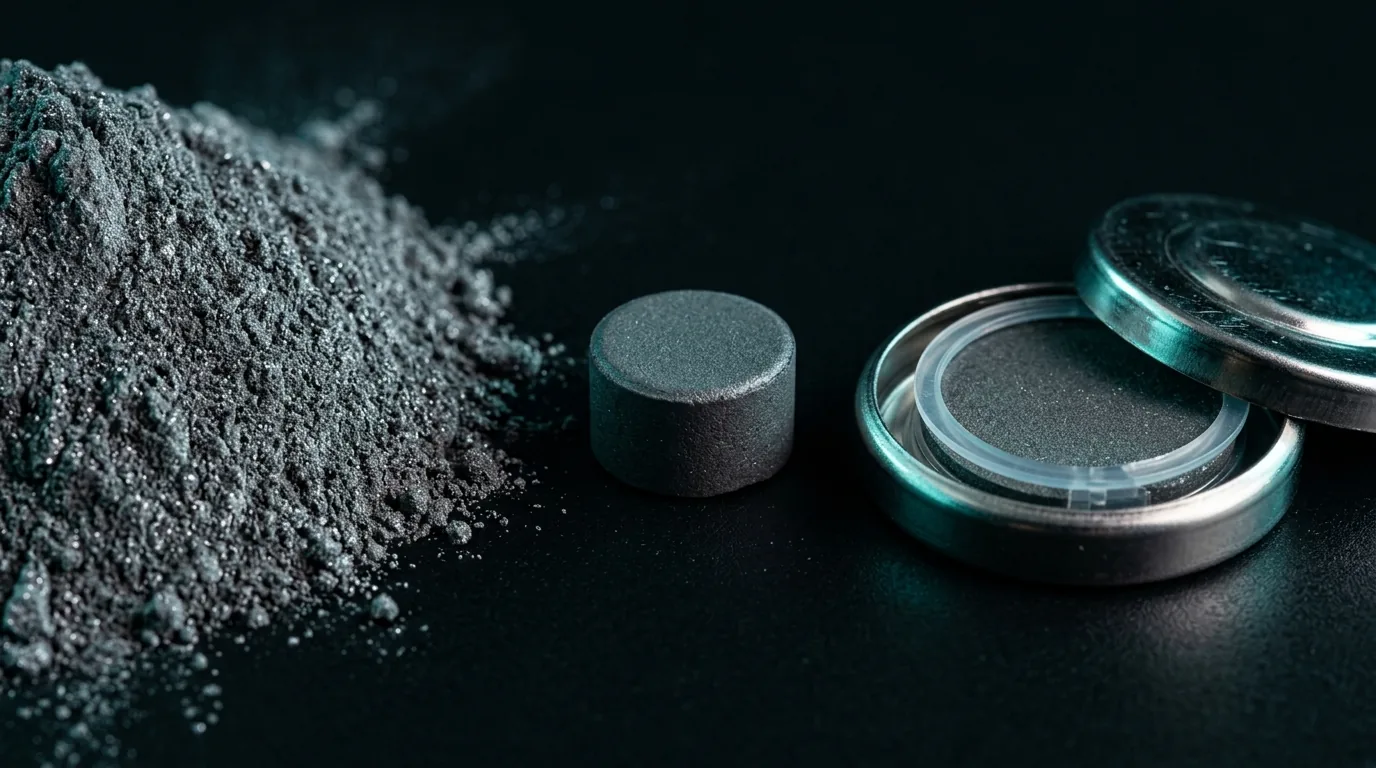
- Cathode powder synthesis by co-precipitation and sol-gel routes
- Ex situ X-ray diffraction and electron microscopy, through collaboration
- DFT calculation of sodium migration barriers and phase stability
Target outcome
A stationary storage chemistry qualified for the humid tropical climate, assemblable from lithium-free resources, and the specification for a pilot assembly line.
Simulated production chain
Assembly line for sodium-ion, lead-carbon and flow cellsFrom precursor co-precipitation to electrochemical cell formation.Related areas

Computational physics
DFT, molecular dynamics, multiphysics simulation: electronic structure, phonon transport and point defects.
Read more
Metrology and secondary standards
A country without secondary standards can neither certify nor export. Fundamental physics with immediate industrial impact.
Read more
Electronic materials from abundant resources
Indium-free transparent conducting oxides, iron-based soft magnetic materials, dielectric ceramics.
Read more