Area 08
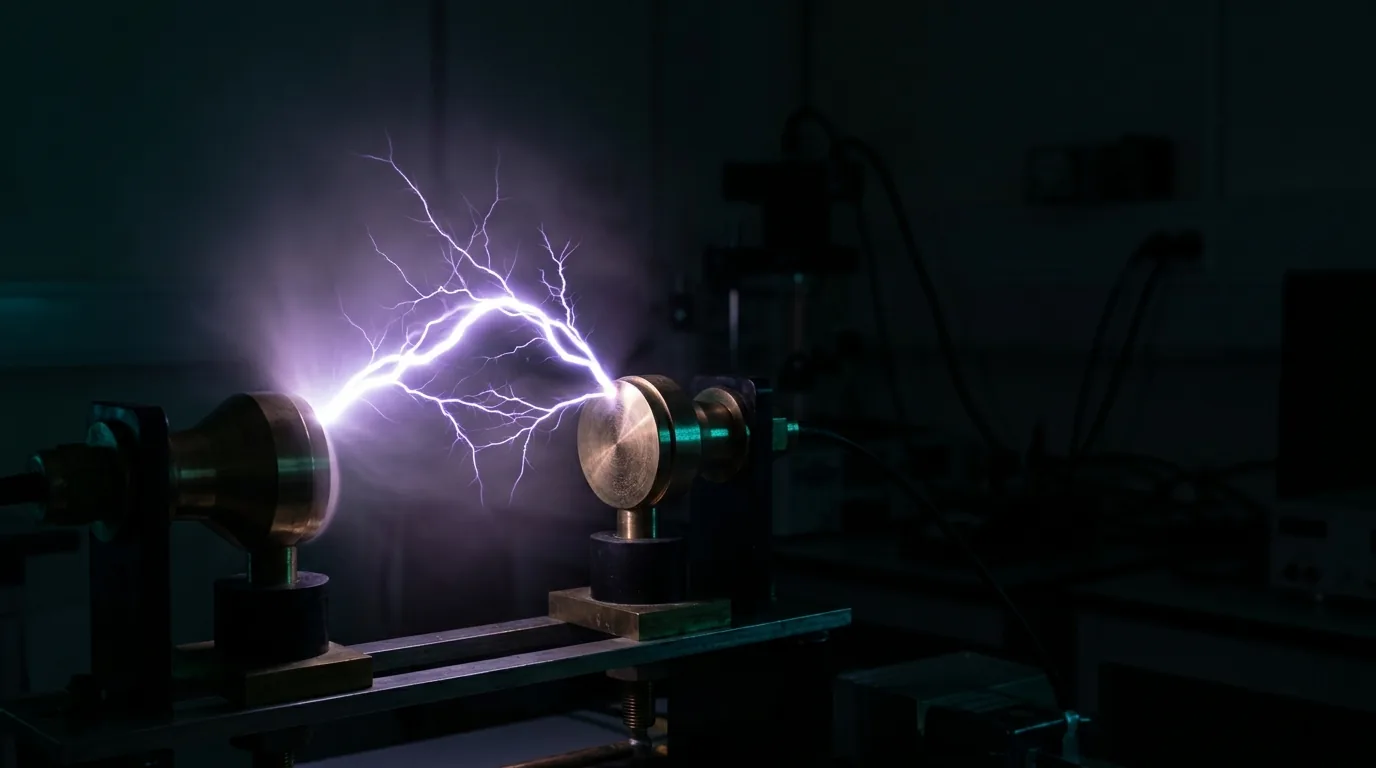
Discharge and lightning physics
The Congo basin is the most thunderstorm-prone region on Earth, and the physics of lightning–grid coupling there is almost unexplored.
Context
The lightning flash density observed over the Congo basin is among the highest on the planet. It is a major constraint on electricity and telecom networks, and for a plasma physicist it is also an observational field with no equivalent.
The lightning current statistics used worldwide to size protection come from measurement campaigns conducted in temperate regions. Nothing guarantees they apply to the deep convective storms of the Congo basin, and nobody has checked.
Open questions
What the literature does not settle
Do the peak-current and front-steepness distributions of return strokes in Congo basin deep convection differ from the reference statistics established in temperate regions?
Electromagnetic coupling of a nearby lightning strike to an overhead distribution line: what share of failures comes from direct strikes, induced voltage and ground potential rise?
Zinc oxide varistors: what conduction mechanisms at the grain boundaries, and how do they degrade under repeated impulses combined with high humidity?
Earthing in lateritic soils whose resistivity varies strongly between seasons: what impulse impedance model, and how should soil ionisation under high current be described?
Can field measurements support a lightning density and risk map directly usable for sizing grid protection under intense storm activity?
Feasibility
Fast electric-field antennas, field mills, Rogowski coils, an impulse generator: the instrumentation is accessible, and the storms to be observed are on site.
Methods and facilities
- Network of atmospheric electric field mills and fast-response antennas
- Correlated recording of disturbances on instrumented distribution lines
- Impulse testing of varistors and surge arresters with degradation tracking
- Soil resistivity measurement in dry and rainy seasons
- Electromagnetic simulation of lightning–line coupling and discharge channel modelling
Target outcome
Lightning statistics specific to regions of very high storm activity, a locally validated line–lightning coupling model, and enforceable protection rules for power and telecom networks.
Simulated production chain
ZnO surge arrester production and site protectionFrom a ceramic grain boundary to the protection design of a line or a plant.Related areas

Reliability physics in tropical environments
Electromigration, board-level corrosion, moisture diffusion in encapsulants, thermomechanical solder-joint fatigue.
Read more
Electronic materials from abundant resources
Indium-free transparent conducting oxides, iron-based soft magnetic materials, dielectric ceramics.
Read more
Metrology and secondary standards
A country without secondary standards can neither certify nor export. Fundamental physics with immediate industrial impact.
Read more